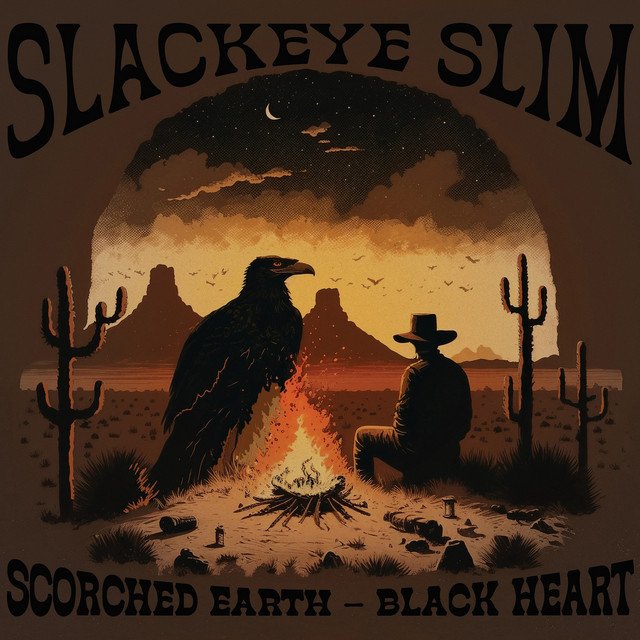
This feels like a long time coming.
That’s something of a twofold statement. Not only is Scorched Earth – Black Heart Slackeye Slim’s first new release in eight years, it’s also the extension of a forgotten time period in country music history that an artist like Slim (the alter ego of Joe Frankland) helped conceptualize – or support the core of, at the very least. Without analyzing its true meaning or arguing the semantics of its name, the surprisingly popular independent country scene of today is a completely different beast from the one of the ‘90s and 2000s (and very early 2010s), when country and punk were close cousins, the appeal was niche, and social media was still too much in its infancy to help it spread further beyond said niche.
It was still, much like today, a melting pot of sounds that couldn’t really be accurately categorized, but as far as western-inspired artists and their releases were concerned, it rarely got better than Slackeye Slim’s El Santo Grial, La Pistola Piadosa, one of my favorite albums of the 2010s for its magnetic splendor. It was, at its core, a western concept album inspired by a dastardly outlaw, and a behemoth in terms of its production style and execution of its concept, finding that wayward soul caught in a literal clash with God that, for as theatrical as its approach sounds, still managed to touch on very real issues concerning ourselves and society at large. The next release, Giving My Bones to the Western Lands, in 2015, felt a lot more purposefully desolate and reflective, consumed by loneliness at every turn but no less alluring for it.
Again, definitely not for everyone, but they were inspired efforts that pushed new boundaries in terms of sound and concept, even despite working within familiar frameworks. Of course, that leaves Slim’s newest album in a weird spot. If previous projects were all about crafting exaggerated tales and outlaw fables for made-up characters who one would nevertheless feel a tinge of empathy for, all while speaking to real themes, this is somehow darker and personal. It’s a turn inward at Slim himself that dives heavily into fraught territory concerning poor mental health and the scars left from old traumas. As such, I can’t say it’s the best introduction to his work, and it does lack the grandiose splendor of his past two albums, but it’s also a deeply rewarding listen should you have the ear for it.
Of course, Slim is also the kind of artist who uses albums as true listening experiences, so it’s not just a western-inspired effort – it’s an album that comes from the bones of those western lands, recorded in a remote studio through several spots in the desert canyons of southwest Colorado. So while familiar trademarks of past albums appear once more: Spanish-flavored acoustics, various percussive elements that can either pound or gallop to ramp up the tension or creep through with rattlesnake-like precision, and yes, a saw to echo the ghostly tension and lonely echoes of the lands, it’s almost purposefully much slower-paced; draining, too. It’s another album where you can hear the windswept cracks breezing through an album set on its own lonesome journey, just somehow with even more harrowing stakes this time around.
And I think it tests Slim himself in new ways, too. His deep, gravelly tone is far from the prettiest, but there’s also something Nick Cave-like to how much that haggard bellow can let loose when the tension finally bursts, especially with the focus squarely (and uncomfortably) on him this time around to let that weariness stand for something more. In saying that, however, this is also an album that unfurls at its own pace. The opener, “Everything Follows This,” establishes most of the main themes of loneliness, anxiety, self-hatred, and, above all else, an emptiness that comes with having to shut down everyone and everything around you when in that state – even your own thoughts. And while that usually comes with a note to push on through regardless, it’s easier said than done, which is what frames the reason behind doing so on “Crooked Teeth” as one of arrogance in feeling destined for more … or just being that wasted away enough not to care either way about anyone’s judgment.
Again … heavy. But given how many albums I’ve written about this year already that touch on these exact themes, there is something a lot more bleak but also likely more realistic to how it handles living like that day to day. And when you couple that haze with an equally slow, methodical dirge through the electric guitars chugging along “Somebody Else’s Name,” it’s not always the easiest album to listen to musically, either. If there’s any silver lining, though, it comes in digging at the root of that anguish and trying one’s best to close the door on old demons. The hard part with that is that it’s usually associated with childhood traumas that don’t heal easily, like having to measure up to a parent’s expectations of who they always wanted to be in life, never letting you be who you really are, on “Mama’s Favorite Son,” or the harrowing depiction of multiple forms of abuse endured from his father on “Old Farmhouse.”
It’s actually there where the album takes a slight turn back in time toward the mountains of Ohio, not only through some stomping banjo grooves to add a bit more kick to a track like “I Took You Up the Mountain,” but also to establish the quaint normalcy in which the events of “Old Farmhouse” are unfortunately told. And all of the buildup established through both the early tracks told from the present day and the tracks that reach back to where the scars were first placed come to a head, starting with “The Worst Part of Me.” Because even in death, when the cause of those scars – be it a person or event – is no longer around to harm someone, the memories stay. And even if we are responsible for our own choices in adulthood, there are still character traits implanted within that are beyond our control to fix or change. It’s a generational cycle of hatred where the worst part of someone becomes the same worst part of the next one in line, even despite – or because of – the deep understanding of the personal pain endured.
I think there’s something even more heartbreaking in that – wanting so badly to rise above knowing it’s possible to be more and be better, but never feeling like it’s a goal within your own individual reach, making any thoughts of dreams turn to pure hatred over what could have been or what will never be. I’d call it a southern Gothic story if there was some deeper promise of beauty or catharsis. But there’s not, and it’s what makes the slow, spare piano ballad in “Goddamnit It’s Christmas” all the more heartbreaking, where despite sharing that same burden with his brothers, there’s a disconnect there they don’t know how to heal, which is what makes the tense, driving “I Took You Up the Mountain” heartbreaking as well as only more fighting ensues. Again, an unforgiving cycle.
If anything, it’s what informs the big epic title track closer split into two parts, first through a moment where in order to finally find some semblance of closure, he realizes he’s got to overcome himself: to let go of feelings that rob him of finding happiness or fulfillment. But it’s really just a lot of depressing wishful thinking, because by the time the second part via a stark piano ballad rolls around, that heart is closed-off, and any temporary solace is just that – temporary, before the dark thoughts and mental anguish come around again. Again, far from an easy listen and not the first album of Slim’s I’d recommend for newcomers. But there is something to be said for how he continuously twists the archetypal journey of the lonesome cowboy searching for greater fulfillment. It peels back the veneer of something epic in favor of spotlighting a very real and human core instead, one where the journey to self-fulfillment may never be reached and where the personal attachment makes for an even bleaker listen. And in twisting that soundtrack as one that’s slower-paced but no less wondrous in how ambitious it’s willing to be to capture specific feelings and moods … well, it’s still another winner. Even just by telling a story like this, there’s at least a little victory to be found.
- Favorite tracks: “Everything Follows This,” “Mama’s Favorite Son,” “I Took You Up the Mountain,” “The Worst Part of Me,” “Goddamnit, It’s Christmas,” “Scorched Earth,” “Black Heart”
- Least favorite track: “Somebody Else’s Name”


 The Musical Divide
I have not heard of this artist but he is very interesting. I have to say when I listened I like most when hearing something new try to make a comparison in my brain. Then I read your insightful analysis and think, wow he is so right! Really well done 👍
LikeLiked by 1 person
I am terrible at replying to comments and I do apologize for that, Randy. But thanks for the kind words! As you know, I appreciate how hard you work at your website, too! 😁
LikeLiked by 1 person
No worries, thanks for that Zack.
LikeLiked by 1 person
holy f’n christ this is hands-down my album of the year (at least for now).
LikeLiked by 1 person