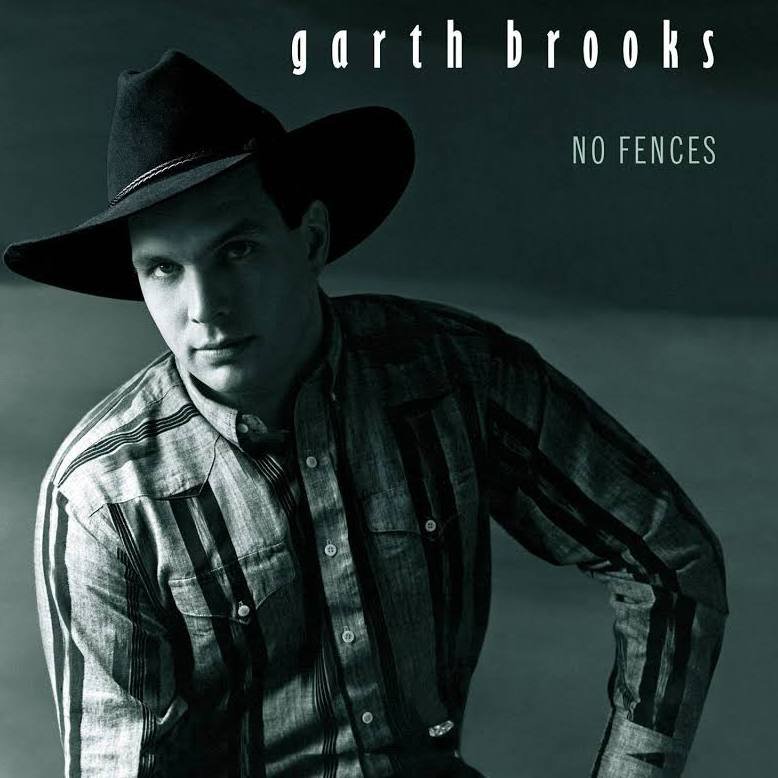
It’s funny. As we slowly exit an exploration of ‘90s country through one feature, we enter another one here. Granted, one feature is centered on individual hits while this one is focused on the album art form, but the same general principle applies: ‘90s country was a big deal, both on the creative and commercial fronts. And to start off our discussion for this decade, we have arguably the biggest name of them all to guide us on why this decade was such a big deal. Of course, given his reputation and general distrust of, well, pretty much anything online, I’m going to refrain from posting audio videos here this time around. Onward!
As noted in our previous discussion of this series – brought to us via Clint Black’s Killin’ Time album – country music’s boom period of the ‘90s owed a lot to the general restructuring that occurred in the latter half of the previous decade, as new names and eclectic sounds emerged to carry it through to the modern era. That discussion was mostly framed by four names: Alan Jackson, Travis Tritt, the aforementioned Black, and Garth Brooks. And in terms of who would be country music’s next superstar, it seemed like Black was set to take that crown.
And for the first couple of years, he did. Tritt had the grit and drive to blend country and southern-rock on his own terms, superstardom be damned. Jackson had a warm, easygoing demeanor that suited his material well even early on that especially helped it age well, even if, like Tritt, there wasn’t anything especially flashy about it that would catapult him to immediate superstardom (that would happen later). Black also had that same low-key charm and wit about him, which is what made his debut such an immediate and enjoyable listen that still holds up as an all-time great listen. And Brooks … well, that’s the thing; not much stood out about him at first.
Granted, given that his influences reportedly ran through everything from Townes Van Zandt, to Tom Rush, Janis Joplin, George Jones, James Taylor, and beyond, he was certainly the most eclectic of the bunch, and that would show itself naturally in time. But upon his debut, Brooks only sported regular-guy looks and a voice that was earnest but not technically stellar. In fact, Brooks and Black were born just three days apart in February 1962, and their debut albums were released in the same week of April 1989. Both collections were even stylistically compatible with one another as mostly straightlaced neotraditional efforts. Brooks, however, had been rejected by every record label in Nashville by 1988, his would-be career only saved by a chance performance at the Bluebird Café, where he sang “If Tomorrow Never Comes” and won over Captiol Records executive Lynn Shults.
To put things further into perspective, Clint Black’s debut album went gold in four months and platinum in eight, the fastest-selling country debut at the time; Brooks’ album didn’t reach the gold plateau until a year after its release. Both “If Tomorrow Never Comes” and “Much Too Young (to Feel This Damn Old)” performed well on the country charts, but it would be the album’s third single, “The Dance,” a song Brooks had heard by writer Tony Arata at a Bluebird writers’ night, that would catapult him into superstardom. Upon its release as a single, the album’s sales doubled within a month.
It’s a ballad about the missed opportunities we take for granted in life, which, when combining its universally relatable sentiment with Brooks’ expressive but still tempered delivery, helped support the everyman quality he had sported all along. Of course, there was also a paradoxical flair and passion there, a love informed by his melting pot of musical influences that would inform his slight theatrical bent on record, and especially his live shows unlike anything else seen before in country music.
Basically, Brooks was just like the rest of us, but he was wildly passionate enough to stand out from the crowd and answer the call as country music’s next superstar. And as we move from that debut album into today’s discussion of his sophomore release, No Fences, that much becomes clear. But it’s nearly impossible to talk about the album without first discussing its lead single, “Friends in Low Places,” a monstrous hit that catapulted off of the momentum established by “The Dance” and really helped establish Brooks not only as a country music superstar, but a cultural icon as well. Mark Chesnutt may have covered the song alongside him in 1990, but Brooks’ seedy, devil-may-care rollick positioned for a working class stiff who’s in a social circle where he doesn’t belong is what turned it into an anthem – one where country music’s biggest superstar was happy to represent the format and bring new fans into the fold, rather than try and sand away the edges for greater crossover appeal.
I just made someone out there mad with that statement, but Brooks is arguably the biggest and best ambassador we’ve had for the format … pretty much ever (and now, not only is someone mad, they’ve vowed never to read this website again). But it also makes for an interesting discussion regarding his sophomore album as a whole, a more confident effort than his debut that shows far greater character overall, but also one that came when Brooks could deliver a big sentiment without overselling it. And that’s what, at the very least, likely makes it the most even-keeled album of his discography, for better or worse.
I’m of two minds on that, because at the album’s best, like the aforementioned “Friends in Low Places” and “The Thunder Rolls,” you hear a consummate showman with an earnest sense of charisma who can nail a variety of different tones and moods. But those two songs I just mentioned were also huge single releases from the album, along with “Unanswered Prayers,” a ballad punctuated by strings that also aims high in its overall emotional impact; it’s not as seedy as the former or as dark as the latter, but it joins their ranks nevertheless by aiming big in dramatic impact and coming out stronger and better for it.
But it also doesn’t quite encapsulate the album as a whole, which is a surprisingly low-key and tempered affair by way of its deep-cuts – even “Wild Horses,” if we’re counting it as one here and not as the single release it eventually became years later. It’s not quite the album made for the downtrodden barroom fools like Clint Black’s Killin’ Time, but there is a sense of restraint shown here for underdog characters, all through a lot of quaint songs carried by little more than firm acoustics, gentle keys, and pedal steel. But it also puts the overall listen at odds with the big, anthemic singles, where I’d be tempted to call it a piecemeal project if there wasn’t still that thread of forgotten characters holding it strongly together.
I think that’s an underrated strength of Brooks’ writing: the character detail. Sure, “Unanswered Prayers” may aim for sweet, borderline cloying platitudes in its setup and hook, but it’s framed as a chance encounter with an old flame Brooks once wanted to be with but never had the chance to pursue. And despite that, he’s happy with where life took him, enough to where those strong feelings didn’t even resurface until the actual reunion; even then, both parties admit there’s nothing much there now. That’s sort of the underlying motif of this album as a whole: Despite these characters looking on the outside in at life through past situations they can’t fix, there’s still a sense of hope that guides them onward, regardless if it’s crashing a party and looking the fool on “Friends in Low Places,” or being burned by love yet refusing to give up on the possibilities offered, on both “New Way to Fly” and “Victim of the Game” (a song also recorded by Trisha Yearwood, even though, weirdly enough, neither artist released their respective versions as singles).
Of course, even in love, no one is guaranteed a winner. I could point to the falling out that frames the epic ballad of “The Thunder Rolls” alone as an example – even without that final verse, we know what’s coming – but even tracks like “This Ain’t Tennessee” and “Same Old Story” feature characters that aren’t alone but are still lonely and in search of greater fulfillment they thought they’d surely find. But even then, with Brooks being the empathetic optimist he is, he ends the album with “Wolves,” one of his best-ever cuts that stands as a song for those beaten down and forgotten by life, where his character is thankful for his own secure personal situation but knows hard times don’t discriminate and that anything can change. It’s really just a note of how the winds of fate will blow where they will, and you either find a way to adapt or get dragged down by the hungry, bloodthirsty wolves of life.
So yeah, it’s a surprisingly more thoughtful album than how it may appear on the surface or upon first listen, but I am on the fence about whether I love it as a whole outside of those big hit singles. The cutesy love song via “Two of a Kind, Workin’ On A Full House” is an overly cheesy sentiment on its own and made worse by Brooks’ overcooked delivery. And after hearing him swing for the fences with more robust arrangements and compositions by way of both the sinister murkiness of “The Thunder Rolls” and the general braggadocios swagger of “Friends in Low Places,” it’s a shame that this album mostly settles in quainter, more neutral territory otherwise.
It’s still tasteful and often for the better in regards to the great country ballad of “New Way to Fly” and especially the somber “Wolves,” but it does feel like a missed opportunity in other regards for more conventional tracks like “Victim of the Game,” with its slightly cheesy arena-rock underbelly that never really fluctuates anyway, and the slightly boring “This Ain’t Tennessee.” And in terms of tracks that didn’t need to be here at all, I’d easily point to the tepid Fleetwood Mac cover of “Mr. Blue” that feels paradoxically oversold vocally and lacking in punch otherwise.
Even then, it’s still worth it alone for “The Thunder Rolls” and “Friends in Low Places,” and alongside strong, underappreciated gems in “Wolves” and “New Way to Fly,” there’s enough to appreciate here. But as a transitional effort between a shaky debut and projects that would fully capitalize on Brooks’ superstardom, there is, again, something even-keeled and focused about this project that makes it unique in Brooks’ discography at large. And if it all it took was knocking down a few fences to unleash potential, I say let those wild horses run.
Join me next time, where we’ll talk about another explosive ‘90s country act with an album to match, through Brooks & Dunn and Brand New Man.


 The Musical Divide
I don’t think anyone had an idea how much things would change for Brooks and Country music.
LikeLiked by 1 person
This is my favorite Garth Brooks record. I always had a soft spot for his material as he was my favorite artist and played his music constantly throughout Middle and High School from 04-10. I still play them for the nostalgia. You can say what you want but Garth had great single choices on all his albums and he has a bunch of great deep cuts.
LikeLiked by 1 person